Math Games: Discover Effortless Fun Learning with Stunning Cards & Dice
In today’s rapidly evolving educational landscape, math games have emerged as an innovative and engaging tool to make learning math effortless and enjoyable. As parents and educators strive for inventive methods to instill mathematical concepts, utilizing cards and dice in math games offers a compelling solution. This approach not only enhances children’s understanding of numbers but also makes learning a joyful experience. Let’s delve into how you can revolutionize math learning with engaging and educational math games designed for kids and classrooms alike.
The Power of Math Games in Education
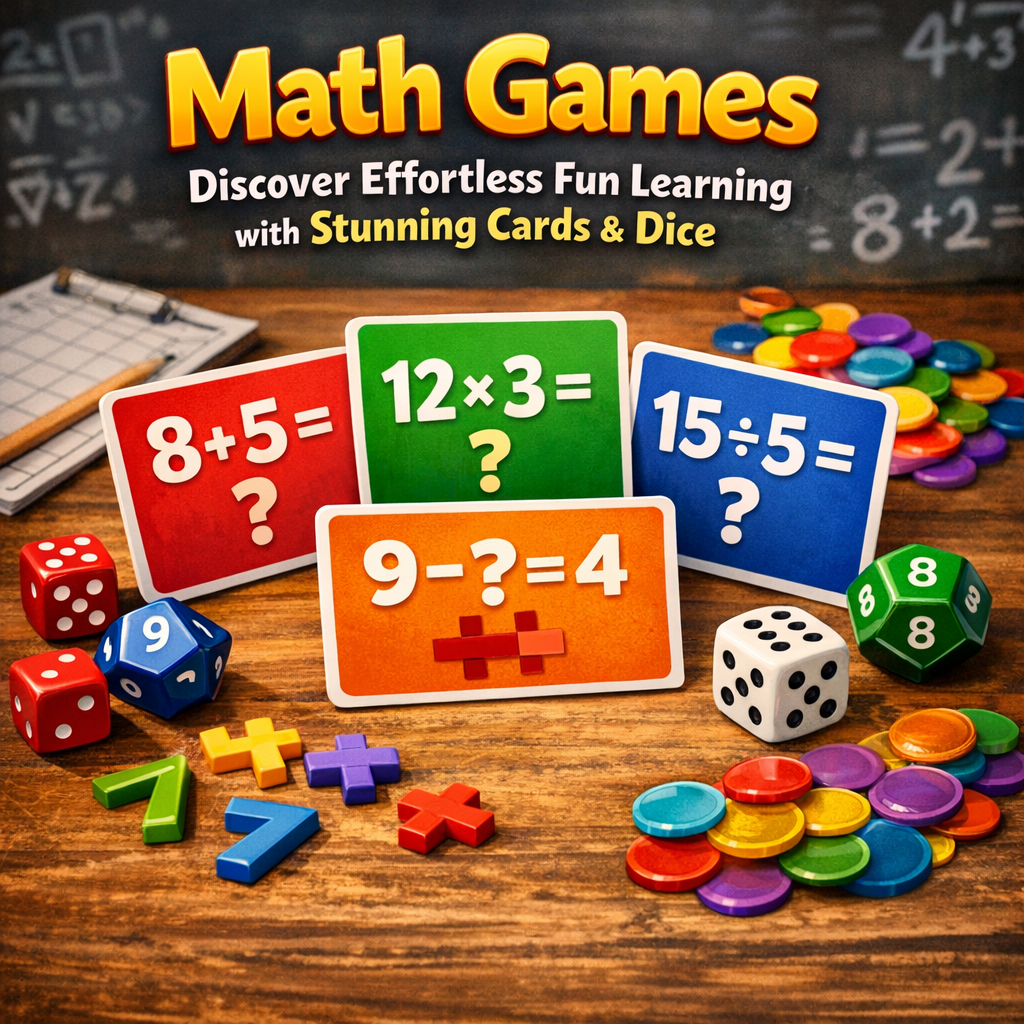
Math games offer a unique blend of fun and learning by transforming abstract mathematical concepts into interactive experiences. By integrating games involving cards and dice, children develop critical thinking skills while engaging in playful competition. This approach not only stimulates a child’s interest in math but also enhances retention and comprehension.
Benefits of Math Games
– Improves Engagement: Interactive games capture children’s attention, making the learning process more dynamic.
– Enhances Problem-Solving Skills: Games require children to think on their feet, fostering quick thinking and solutions.
– Promotes Teamwork: Many math games encourage collaboration, teaching valuable social skills.
– Customizable Learning: Games can be tailored to different age groups and proficiency levels.
Top Card Games for Math Learning
Incorporating card games into math lessons can vastly improve a child’s numerical skills. Here’s how you can use card games for effective math learning:
Addition Snap
Objective: This game focuses on enhancing addition skills.
How to Play:
1. Shuffle a standard deck of cards.
2. Players take turns drawing two cards at a time.
3. Each player quickly adds the numbers on their two cards.
4. The player with the highest sum wins that round.
Benefits: Encourages quick mental calculations and strengthens addition skills.
Math Rummy
Objective: A variation of the classic rummy, focused on forming sets with mathematical operations.
Rules:
1. Deal a predetermined number of cards to each player.
2. Players try to form groups of numbers through simple math operations (e.g., finding three cards that add up to 12).
3. The first player to successfully form their groups wins.
Benefits: Enhances critical thinking and mathematical strategy.
Dice Games that Make Math Fun
Dice games introduce an element of randomness and excitement, ideal for teaching probability and number operations.
Roll and Multiply
Objective: Improve multiplication skills through repetitive practice.
Instructions:
1. Each player takes turns rolling two dice.
2. Multiply the numbers on the dice.
3. Record the results to track improvement over several rounds.
Benefits: Reinforces multiplication tables in a fun, engaging way.
Probability Challenge
Objective: Teach foundational concepts of probability.
Game Play:
1. Roll a single die.
2. Players predict outcomes of future rolls.
3. Discuss the probability of each outcome, enhancing understanding of chance and prediction.
Benefits: Provides a hands-on understanding of probability and statistics.
Incorporating Math Games in the Classroom
Introducing math games into the classroom environment requires careful planning. Here are some strategies for a seamless integration:
Creating a Math-Positive Environment
– Designate Game Time: Allocate specific periods during the week for math games.
– Encourage Participation: Use games as a reward to motivate participation in other activities.
– Develop Team Challenges: Encourage teamwork and collaboration through group challenges.
Aligning Games with Curriculum
Ensure that the math games align with the curriculum’s learning objectives. Identify key areas where students need reinforcement and select games that address those areas. This approach ensures that while students have fun, they also make measurable progress in their learning objectives.
Using Technology to Enhance Math Game Experience
With digital platforms, the scope of math games expands significantly, providing an interactive, modern approach to learning.
Apps and Online Resources
Incorporate educational apps like the Brain Baba Kids Learning App to supplement traditional math games. These apps offer:
– Adaptive Learning: Customized difficulty based on the user’s progress.
– Interactive Graphics: Engaging designs that make learning visually stimulating.
– Progress Tracking: Features that allow educators and parents to track progress and areas for improvement.
Virtual Dice and Card Tools
Utilize online dice and card tools to replicate the experience digitally. These tools provide:
– Accessibility: Students can play from home, integrating tech into home learning.
– Variety: A wide array of games beyond physical cards and dice.
FAQ: Maximizing The Impact of Math Games
How do math games support different learning styles?
Math games are versatile and can be adapted to visual, auditory, and kinesthetic learners. Through interactive and engaging approaches, these games cater to the diverse needs of students, ensuring holistic development.
What age groups can benefit from math games?
Math games can benefit a wide range of age groups, from preschoolers to elementary students. The key is to select games that match the cognitive and skill levels of each group, ensuring a challenging yet accessible experience.
Can math games replace traditional teaching methods?
While math games significantly enhance learning, they should complement rather than replace traditional methods. Integrating games with direct instruction provides a balanced approach, harnessing the benefits of both strategies.
How often should math games be played in the classroom?
Math games can be played regularly as part of a mixed-method teaching plan. Weekly sessions can keep students engaged without overwhelming them, ensuring a sustained interest and gradual improvement in skills.
Are there game options for advanced students?
Certainly! Games can be modified to include complex problems and critical thinking challenges. Incorporating multi-step word problems or sophisticated probability puzzles can cater to advanced learners.
Conclusion: Elevate Math Learning with Fun and Interactive Games
Math games, enriched with the use of cards and dice, offer a transformative approach to learning. By combining educational objectives with dynamic gameplay, children are not only learning but also developing a love for mathematics. Encourage your child’s learning journey today with these innovative strategies. For more resources and interactive experiences, explore tools like the Brain Baba Kids Learning App. Transform math from a mundane subject into an exciting adventure!
Embrace the fusion of fun and education by integrating math games into your teaching arsenal. Start today, and watch as your students develop into confident, enthusiastic learners.