Math Puzzles: Must-Have Brain Logic for Effortless Learning
As parents and educators, we are continually seeking innovative and effective methods to foster children’s learning abilities. One powerful tool in this educational arsenal is math puzzles, a form of brain logic exercise that promotes effortless learning across various subjects. Integrating math puzzles into educational activities not only strengthens numerical skills but also enhances critical thinking and problem-solving abilities, setting a foundation for lifelong learning.
The Importance of Math Puzzles in Education
Enhancing Cognitive Abilities
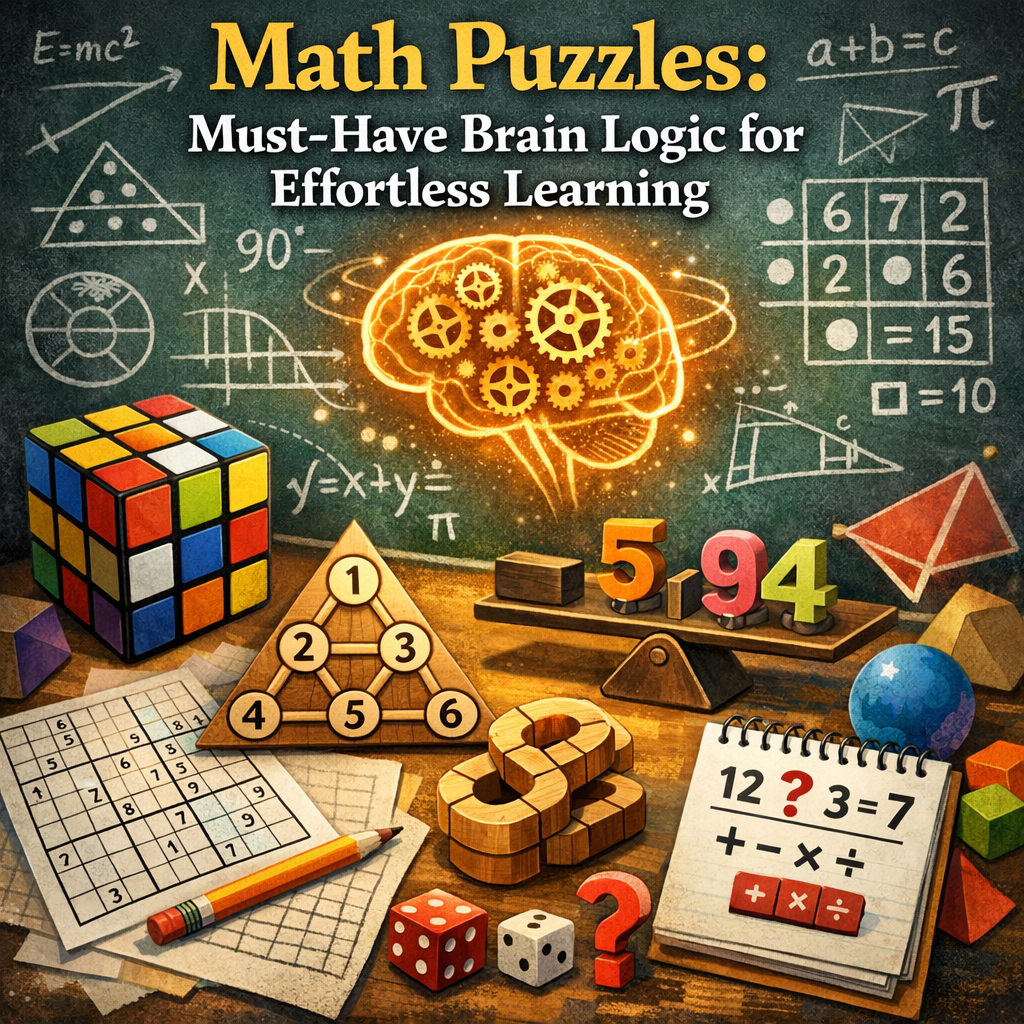
Math puzzles are much more than mere games; they serve as essential tools to enhance cognitive abilities. Exposure to these puzzles stimulates the brain, promoting neural connectivity and encouraging the development of logical thinking. By tackling these engaging challenges, children learn to approach problems methodically, a skill that carries over into other academic areas.
Building Problem-Solving Skills
At the core of math puzzles is the enhancement of problem-solving skills. When children engage in activities like Sudoku, crosswords with a numerical twist, and other logic-based games, they learn to interpret information, identify patterns, and apply strategic thinking. These skills are pivotal not only in mathematics but also in real-life decision-making scenarios.
Encouraging a Growth Mindset
Math puzzles cultivate a growth mindset by empowering children to tackle challenges without fear of failure. This mindset is crucial for academic success, as it fosters a love for learning and resilience against setbacks. Through persistent effort in solving puzzles, children understand that intelligence and abilities can be developed with dedication and hard work.
Integrating Math Puzzles into the Curriculum
Selecting Age-Appropriate Puzzles
To achieve the greatest educational benefit, it is important to select math puzzles that align with a child’s developmental stage. For younger children, simple puzzles involving basic arithmetic or pattern recognition are ideal. As children progress, more complex puzzles like algebraic equations and geometric challenges can be introduced.
Examples of Age-Appropriate Puzzles:
– Ages 4-6: Simple number matching and counting puzzles
– Ages 7-9: Basic Sudoku and pattern identification
– Ages 10-12: Intermediate Sudoku and logic grid puzzles
– Ages 13 and up: Algebraic puzzles and advanced logic riddles
Encouraging Collaborative Learning
Math puzzles can be adapted to encourage collaborative learning among peers. Group-based puzzle-solving activities promote teamwork, communication, and the ability to view problems from multiple perspectives. These are crucial life skills that benefit children far beyond the classroom.
Incorporating Technology
The digital age offers numerous tools and apps that make incorporating math puzzles into learning seamless and engaging. Resources like the Brain Baba Kids Learning App provide interactive platforms where children can explore puzzles and challenges tailored to their learning level. By leveraging technology, educators can offer diverse, adaptive, and interactive learning experiences.
Practical Tips for Parents and Educators
Creating a Puzzle-Solving Environment
Establishing a conducive puzzle-solving environment at home or in the classroom can significantly enhance learning. Ensure there is a quiet space free from distractions, equipped with all necessary materials such as pencils, erasers, and a comfortable workspace.
Setting Achievable Goals
Encourage children to set and achieve realistic goals when engaging with math puzzles. This might include solving a certain number of puzzles each week or mastering a new type of logic challenge. Goal-setting reinforces motivation and provides a sense of accomplishment.
Providing Feedback and Encouragement
Offering constructive feedback and encouragement boosts children’s confidence and willingness to tackle new puzzles. Highlight successes, discuss strategies for improvement, and celebrate when children overcome particularly challenging puzzles.
Using Math Puzzles for Assessment
Educators can use math puzzles as an innovative and engaging form of assessment. By analyzing how students approach and solve puzzles, teachers gain insights into their problem-solving methods and identify areas where additional support may be needed.
Benefits of Math Puzzles Beyond Math
Language Skills Development
Interestingly, math puzzles also contribute to the development of language skills. Many puzzles require reading comprehension and the ability to follow complex instructions, which enhances vocabulary and language proficiency. This dual focus supports integrated learning and cognitive flexibility.
Enhancing Memory and Concentration
Regular engagement with math puzzles strengthens memory and concentration. The focus required to solve puzzles helps improve attention span, which is beneficial not only in academic settings but also in everyday tasks and interactions.
Encouraging Creativity
Despite their logical nature, math puzzles often require creative thinking to find solutions. This blend of creativity and logic stimulates a part of the brain that nurtures innovation and original thinking, which are invaluable skills in today’s rapidly changing world.
Promoting Emotional Well-being
The challenge and subsequent success experienced through solving math puzzles provide emotional rewards. They instill confidence and a sense of achievement, reducing anxiety and promoting a positive attitude towards learning and problem-solving.
Frequently Asked Questions
What age group can benefit most from math puzzles?
Math puzzles can be adapted to suit all age groups, making them versatile educational tools. From simple counting games for preschoolers to complex logic puzzles for high school students, there is a broad spectrum of activities to engage learners of all ages.
How can I find math puzzles suitable for my child’s skill level?
Start by assessing your child’s current mathematical skills and cognitive abilities. Many educational websites and apps like the Brain Baba Kids Learning App offer categorized puzzles by difficulty level, enabling parents and educators to select appropriate challenges.
Can math puzzles help with standardized test preparation?
Absolutely. Math puzzles enhance problem-solving abilities, logical thinking, and analytical skills, all of which are crucial for standardized tests. They offer engaging practice that complements traditional test preparation methods.
What’s the best way to motivate my child to engage with math puzzles?
Incorporate puzzles into daily routines and celebrate successes, however small. Providing a mix of puzzles related to your child’s interests and offering rewards for completed challenges can make the experience enjoyable.
Are there drawbacks to using math puzzles in education?
While math puzzles are beneficial, they should complement, not replace, other forms of learning. Ensuring a balanced approach that incorporates diverse educational activities is essential for comprehensive development.
Conclusion
Math puzzles are invaluable educational tools that stimulate brain logic and foster a multitude of essential skills, ranging from problem-solving to creativity. By integrating these puzzles into daily learning experiences, educators and parents can cultivate a challenging yet supportive environment where children thrive academically and personally.
Explore the world of math puzzles and watch your child’s confidence, skills, and love for learning grow. Encourage young minds to solve puzzles and embrace learning opportunities throughout their educational journey.
To get started, explore interactive resources like the Brain Baba Kids Learning App today and transform your approach to math education.