Water Science Wonders: Must-Try Home Experiments for Effortless Fun
Water is a vital component of our world and a fascinating subject for scientific exploration. Discovering the wonders of water science through home experiments offers effortless fun and educational value for both children and adults. In this article, we’ll delve into a variety of exciting experiments that can be easily performed at home, exploring the science behind each activity and offering insights that make learning an engaging experience. By using these hands-on experiments, you can transform your home into a vibrant science lab, sparking curiosity and understanding in playful ways.
The Magic of Water: An Introduction to Home Experiments
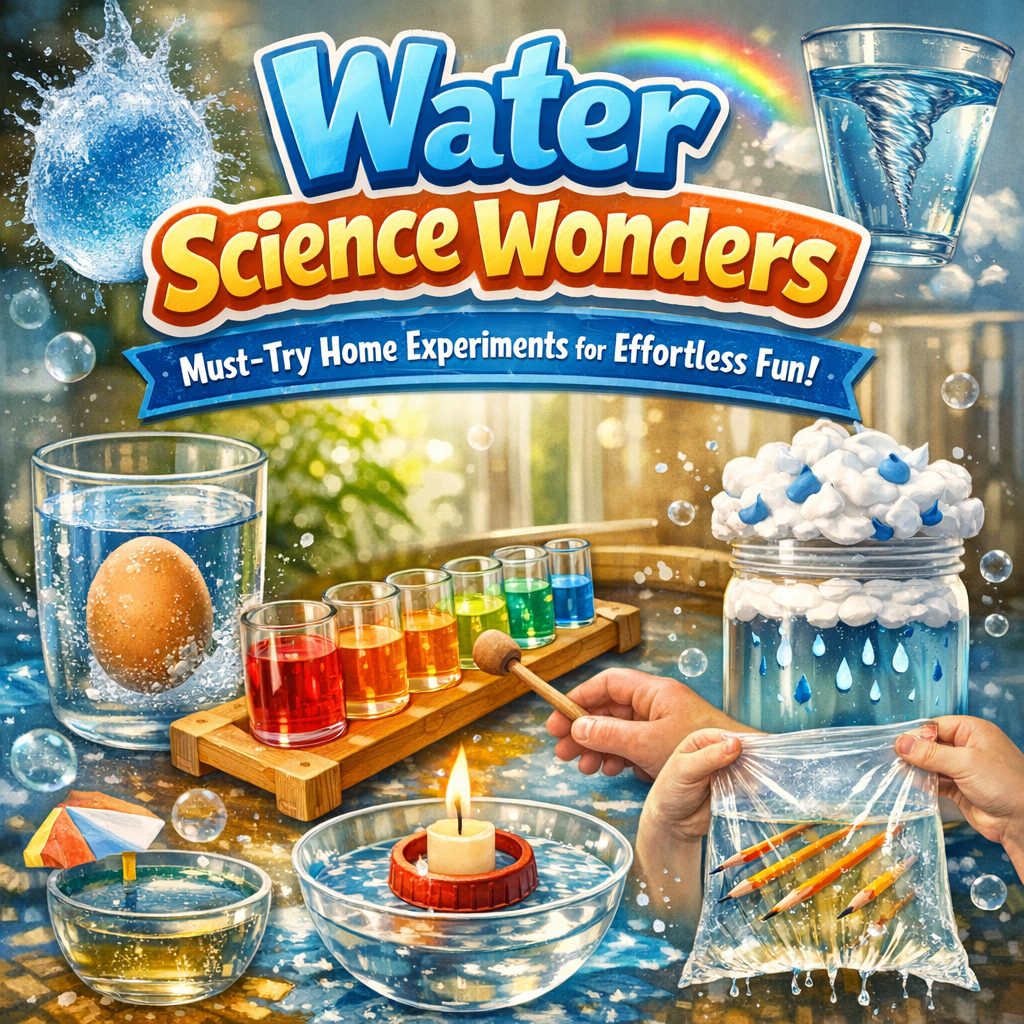
Water science opens the door to endless possibilities for exploration and learning. By experimenting at home, families and educators can cultivate a deeper understanding of fundamental scientific concepts — all while having fun. Whether you’re looking to teach children about surface tension, buoyancy, or states of matter, these easy-to-set-up experiments provide opportunities to engage with science in an intuitive and enjoyable manner.
These experiments not only enhance your understanding of water’s unique properties but also foster a love for discovery. Let’s dive into the diverse world of water science with these must-try home experiments.
Understanding Water’s Properties
What Makes Water So Special?
Water, a compound composed of two hydrogen atoms and one oxygen atom, is unique due to its molecular structure and versatile properties. Its ability to exist in three states — solid, liquid, and gas — makes water an ideal candidate for scientific experiments at home. Here’s why water science is worth exploring:
– Cohesion and Adhesion: Water molecules stick together through cohesion and to other substances through adhesion, enabling phenomena like capillary action.
– Surface Tension: This is the elastic tendency of liquids that makes water surfaces act like a stretched elastic membrane, crucial for various water-based experiments.
– Density and Buoyancy: Water’s density influences buoyancy, allowing some objects to float while others sink — a fundamental lesson in physics.
– Thermal Properties: Water’s high specific heat capacity means it can store and release large amounts of heat, influencing weather patterns and climates.
By exploring these concepts through practical experiments, children and adults alike can gain a hands-on understanding of water’s special characteristics.
Experiment 1: The Invisible Force of Surface Tension
Exploring Water’s Elastic Skin
Materials Needed:
– Shallow dish
– Water
– Black pepper
– Liquid dish soap
Instructions:
1. Fill the shallow dish with water.
2. Sprinkle a liberal amount of black pepper over the water’s surface.
3. Dip a finger into the dish soap and then touch the center of the water’s surface.
What Happens and Why:
Upon touching the water with the soapy finger, the pepper rapidly disperses towards the edges of the dish. This is due to the disruption of water’s surface tension by the soap, providing a visual demonstration of surface tension’s invisible force.
Learning Points:
– Surface tension allows water to resist external force, maintaining its surface integrity.
– Soap reduces the surface tension, affecting how water behaves.
Experiment 2: Marvelous Density – The Floating Egg
Understanding Buoyancy and Density
Materials Needed:
– 1 raw egg
– Water
– Salt
– Two clear glasses
Instructions:
1. Fill the first glass with plain water and gently place the raw egg inside.
2. Observe the egg sinking to the bottom.
3. In the second glass, dissolve several tablespoons of salt in water, stirring until fully dissolved.
4. Place the egg in the salted water.
What Happens and Why:
The egg floats in the saltwater due to increased water density. Saltwater is denser than freshwater, affecting buoyancy and allowing the egg to float.
Learning Points:
– Understanding density and buoyancy through simple alterations in water composition.
– Relating density concepts to real-world applications, such as saltwater bodies.
Experiment 3: Captivating Chromatography
Separating Colors with Water
Materials Needed:
– Coffee filters
– Washable markers
– Glasses
– Water
Instructions:
1. Draw a thick circle near the center of the coffee filter with a marker.
2. Fold the coffee filter into a cone and place the tip in a glass with a small amount of water (water should not touch the marker).
3. Watch as the water travels up the paper, separating the ink into different colors.
What Happens and Why:
This experiment exhibits paper chromatography. The water moves through the filter, carrying and separating the water-soluble ink based on different dyes’ solubility and capillary action.
Learning Points:
– Understanding chromatography as a method of separation, relevant in scientific research and forensic science.
– Demonstrating the principles of capillary action and solubility.
Experiment 4: Leak-Proof Water Bag
Exploring Molecular Bonds and Strength
Materials Needed:
– Plastic ziplock bag
– Pencils
– Water
Instructions:
1. Fill the plastic bag halfway with water and seal it tightly.
2. Carefully push a sharpened pencil through one side of the bag and out the other, without spilling any water.
What Happens and Why:
The pencil pierces the bag without causing leaks due to water molecules forming a temporary seal around the pencil. This demonstrates the strength of molecular bonds and the plastic bag’s elastic properties.
Learning Points:
– Understanding molecular cohesion and elasticity.
– Real-world applications in waterproof clothing and containers.
Experiment 5: Sugar Density Rainbow
Creating Colorful Layers with Different Densities
Materials Needed:
– Four clear glasses
– Water
– Sugar
– Food coloring
Instructions:
1. Add different amounts of sugar into each glass (e.g., 1 tbsp, 2 tbsp, etc.).
2. Add equal amounts of water into each glass and stir until the sugar dissolves.
3. Add different food colorings to each glass.
4. Carefully layer the colored sugar solutions into one glass, starting with the highest sugar concentration.
What Happens and Why:
The solutions form distinct layers due to varying densities. The more sugar solution is denser, allowing it to sink below less concentrated solutions, creating a rainbow effect.
Learning Points:
– Understanding solubility and its impact on density.
– Relating the concept of density gradient to topics in chemistry and the environment.
Internal Links to Related Content
Explore more exciting activities in our Top 10 Indoor Science Experiments for Kids and understand the principles of Physics in Everyday Life for more engaging insights. Don’t miss our guide on Interactive Learning Resources for Home Education for further educational activities.
Harnessing Technology: Integrate Learning Apps
To augment your child’s learning experience, consider using digital resources like the Brain Baba Kids Learning App. This app provides an interactive platform for children to explore and understand various scientific concepts through engaging activities and lessons.
FAQ Section
What is water science?
Water science refers to the study of water’s physical and chemical properties and its interactions with other elements. It includes topics like water’s molecular structure, surface tension, buoyancy, and the hydrological cycle.
Why are home experiments important for learning science?
Home experiments provide tangible, hands-on experience, helping to reinforce theoretical concepts learned in the classroom. They engage learners actively, making complex topics more accessible and enjoyable.
How can I encourage my child’s interest in science through water experiments?
Start with simple, visually engaging experiments like the ones outlined here. Encourage questions, be supportive of trial and error, and relate these activities to everyday situations to make them relevant and exciting.
Are these experiments safe for young children?
Yes, these experiments are designed to be safe and suitable for supervised young children. Always ensure adult supervision to maintain a safe learning environment, especially when handling objects like sharp pencils or glass.
Can these experiments be conducted with household items?
Absolutely! All of the experiments described can be performed with common household materials, ensuring they are easy to organize and conduct at home.
Conclusion: Dive Into the Wonders of Water Science
Water science experiments are a simple yet powerful way to engage with the natural world, sparking curiosity and fostering a love for learning. By experimenting with water’s unique properties, both children and adults can enjoy educational fun that lays the foundation for scientific understanding.
Get started today with these engaging water science experiments and see how they can transform your home into a lively hub of discovery. Engage your family, stimulate minds, and perhaps uncover the next generation of innovators in the comfort of your living room.
Embark on this journey today, and don’t forget to explore the resources available on our site and download the Brain Baba Kids Learning App for an enriching educational experience.