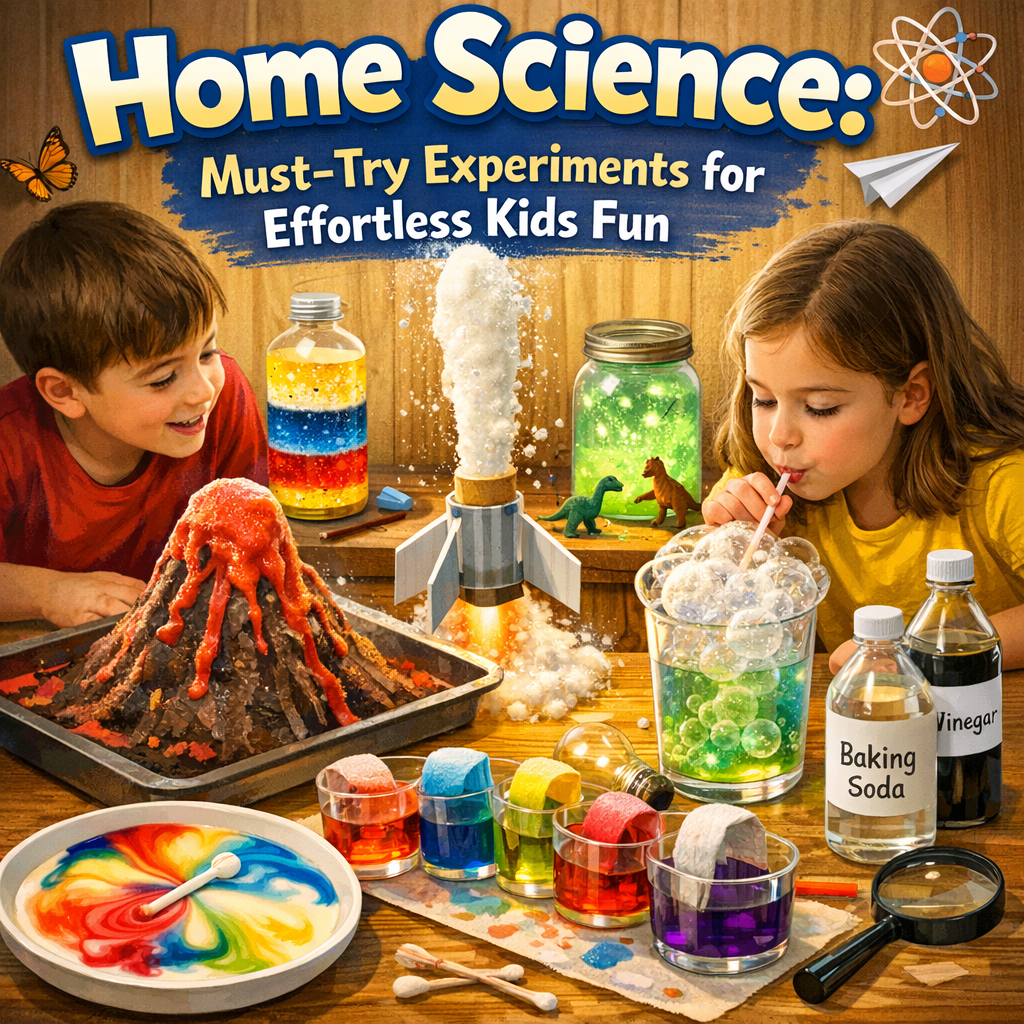
Home Science: Must-Try Experiments for Effortless Kids Fun
In today’s fast-paced digital age, engaging children in hands-on learning experiences is more crucial than ever. Home science experiments are an excellent way to captivate young minds, encouraging them to explore, discover, and understand the world around them. Not only do these experiments bring a dose of fun, but they also foster critical thinking and problem-solving skills. In this comprehensive guide, we’ll explore several enriching home science experiments that promise effortless fun for kids.
Table of Contents
1. Introduction to Home Science
2. Benefits of Kids Experiments
3. Essential Safety Tips
4. Must-Try Experiments
– Balloon Rocket
– Invisible Ink
– Homemade Volcano
– Rainbow in a Jar
– Crystal Growing
5. Incorporating Science into Daily Life
6. Resources and Tools for Parents and Educators
7. FAQs
8. Conclusion
Introduction to Home Science
Home science is all about making learning interactive, fun, and accessible right from the comfort of your home. By conducting kids experiments with everyday materials, you can introduce scientific concepts in an engaging manner. Experiments such as creating simple rockets or growing crystals are not only fascinating but offer a way to bond with your child while nurturing their innate curiosity.
Benefits of Kids Experiments
Engaging in home science experiments provides numerous benefits, including:
– Enhanced Learning: Kids grasp scientific concepts better when they see them in action.
– Skill Development: Improves problem-solving, creativity, and critical thinking.
– Curiosity and Exploration: Encourages questioning and experimentation.
– Emotional Growth: Builds confidence and persistence through trial and error.
Essential Safety Tips
Before you dive into the fun world of experiments, keep these crucial safety tips in mind:
– Adult Supervision: Always oversee experiments to ensure safety.
– Read Instructions Carefully: Understand each step before proceeding.
– Use Safe Materials: Use non-toxic, child-friendly substances.
– Proper Ventilation: Ensure the area is well-ventilated, especially for experiments involving chemicals.
Must-Try Experiments
Balloon Rocket
Materials Needed:
– A balloon
– A long string
– A straw
– Tape
Instructions:
1. Setup: Thread the string through the straw and tie the ends to two fixed points.
2. Inflate Balloon: Blow up the balloon without tying it, then tape it to the straw.
3. Launch: Release the balloon and watch it propel the straw along the string.
Science Behind It:
This experiment demonstrates Newton’s Third Law of Motion: for every action, there’s an equal and opposite reaction. The air escaping from the balloon pushes it forward, much like a rocket.
Invisible Ink
Materials Needed:
– Lemon juice or milk
– Cotton swab
– White paper
– Heat source (like a light bulb)
Instructions:
1. Create Message: Dip the cotton swab in lemon juice or milk, write a secret message on the paper.
2. Reveal Message: Once dry, hold the paper near a light bulb. The heat will reveal your message.
Science Behind It:
Lemon juice oxidizes and turns brown when heated, revealing the hidden writing. This experiment introduces concepts of chemical reactions and oxidation.
Homemade Volcano
Materials Needed:
– Baking soda
– Vinegar
– Food coloring
– Small container
Instructions:
1. Build Volcano: Place the small container in the center of a tray and build a mound around it using clay or dough.
2. Activate Eruption: Add baking soda into the container, then pour in vinegar mixed with a few drops of food coloring.
Science Behind It:
This fun experiment showcases an acid-base reaction. Baking soda (a base) reacts with vinegar (an acid) to produce carbon dioxide gas, creating an “eruption”.
Rainbow in a Jar
Materials Needed:
– Honey
– Dish soap
– Water
– Olive oil
– Rubbing alcohol
– Food coloring
Instructions:
1. Layer Liquids: Carefully layer honey, colored dish soap, colored water, oil, and rubbing alcohol in a clear jar.
2. Observe: Watch as the liquids form distinct layers, resembling a rainbow.
Science Behind It:
Different liquids have varying densities, causing them to layer instead of mixing. This visually stunning experiment demonstrates principles of density and buoyancy.
Crystal Growing
Materials Needed:
– Borax
– Pipe cleaners
– Water
– Jar
Instructions:
1. Shape & Suspend: Shape a pipe cleaner into a design and suspend it in a jar.
2. Prepare Solution: Dissolve borax in boiling water, then pour into the jar.
3. Wait & Watch: Over the next few days, observe as crystals form on the pipe cleaner.
Science Behind It:
As water cools and evaporates, borax returns to its solid state, forming crystals. This experiment highlights concepts of saturation and crystallization.
Incorporating Science into Daily Life
To fully leverage the benefits of home science, weave experiments into your daily routine:
– Cooking: Discuss the chemistry of baking.
– Gardening: Explore plant biology and photosynthesis.
– Weather Tracking: Study meteorology by keeping a weather journal.
Encouraging questions and exploring answers together makes science a continuous conversation rather than a one-time activity.
Resources and Tools for Parents and Educators
Providing kids with the right resources and tools can enhance their learning journey:
– Apps and Online Tools: Try the Brain Baba Kids Learning App for interactive science activities.
– Books and Kits: Science kits and guides provide structured learning paths.
– Community Workshops: Local libraries and community centers often offer workshops.
Explore our other resources to find additional guides and tools that can supplement your child’s science education.
FAQs
1. How can I ensure my child stays safe during experiments?
Always supervise experiments, use non-toxic and age-appropriate materials, and follow step-by-step instructions. Implementing these measures ensures a fun and safe learning environment.
2. What age is suitable for these home science experiments?
Most of these experiments are suitable for ages 5 and up, with varying levels of parental involvement required. Tailor the complexity based on your child’s understanding and interest.
3. How often should we conduct science experiments at home?
Aim to include science experiments in your weekly routine. Regular exposure keeps children engaged and continuously learning. Check out our weekly science challenge ideas for inspiration.
4. Can these experiments be adapted for group activities?
Absolutely! Experiments like the balloon rocket or rainbow in a jar are perfect for group settings, fostering teamwork and collaborative learning. Check our guide on science activities for classrooms for more group ideas.
5. Where can I find additional experiments to try?
Explore science websites, apps like Brain Baba, or visit our comprehensive experiment database for a plethora of ideas and activities.
Conclusion
Home science experiments offer a delightful blend of fun and education, making scientific concepts accessible and enjoyable for children. By integrating these activities into your routine, you open the door to a world of discovery that captivates young minds. Now is the time to ignite your child’s curiosity—dive into the world of home science today!
For more guidance, explore our site for related content and resources. And don’t forget, with the Brain Baba Kids Learning App, you have a handy tool to enrich your child’s science journey. Let’s make learning an adventure they’ll always cherish!